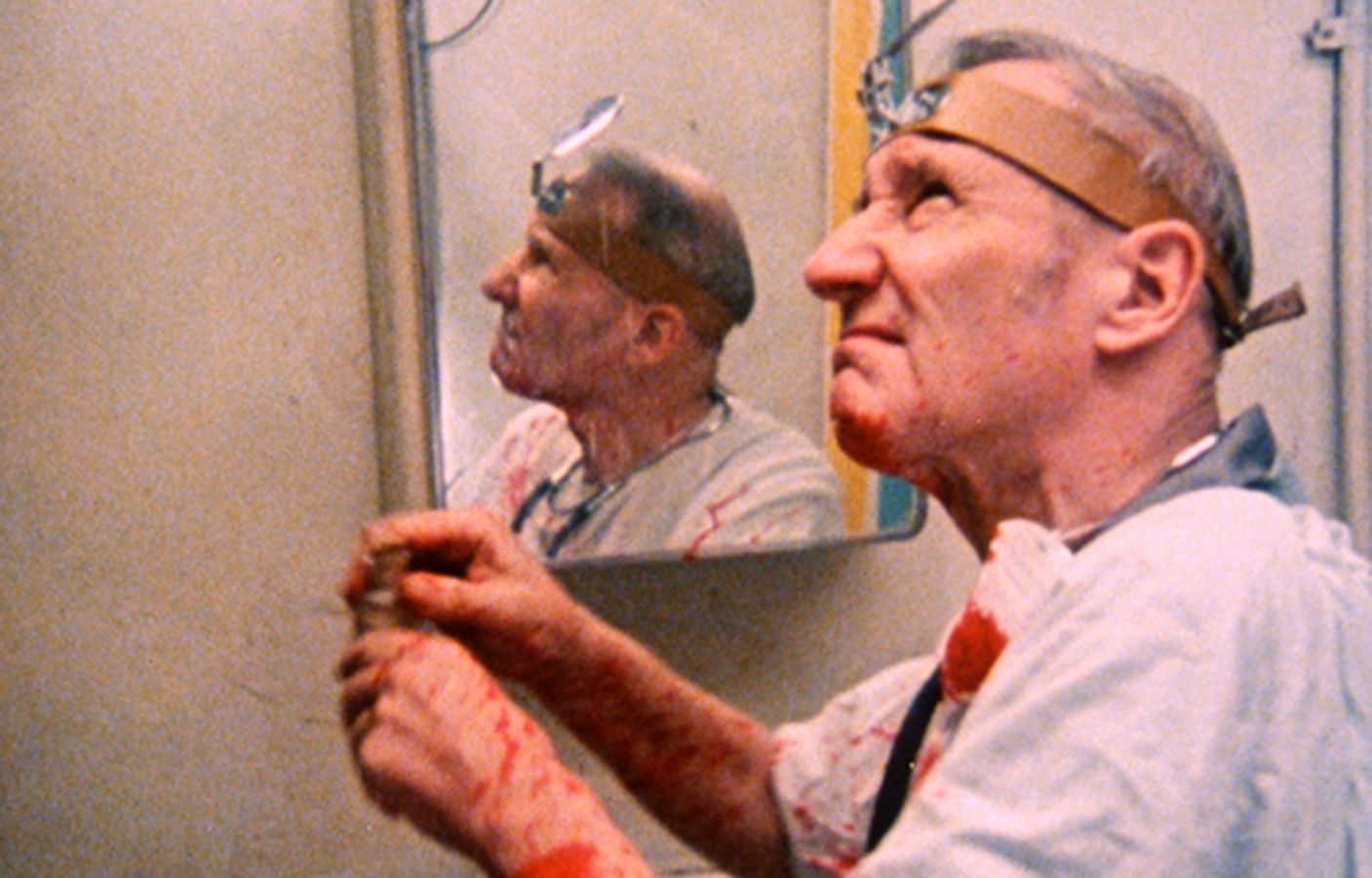
Click on the image above for the full movie.
Thursday, August 13, 2026
Ghosts of Tangier
Sunday, March 01, 2026
"The Center Street Cut-Ups"
Sunday, November 30, 2025
Horror Hospital
Robin Askwith (just prior to his shift into a sex comedy franchise) is a stressed out singer with a pop group. He decides to go for some R&R at a country retreat. He hooks up with Vanessa Shaw on the train journey in, and once they arrive at the retreat they find it's a bizarro world inhabited by mute bikers, lobotomised robots, a malignant dwarf and a mad doctor (Michael Gough) in a wheelchair!
Saturday, November 25, 2023
With BRION GYSIN in Paris - from Genesis P-Orridge's lost UK-archive
Thursday, September 07, 2023
Naked Lunch (1991)
The adaption of the 1959 novel by William Burroughs by David Cronenberg. The film sits between the novel and Burroughs biography. It captures the sentiment of Burroughs' writing well, but it does not reproduce the dark, chaotic and humorous qualities of the novel. For the dedicated Burroughs fan or curious novice, the film should be accompanied by the novel (I have read it 5 times and did my MA thesis on it), along with Literary Outlaw: The Life and Times of William S. Burroughs by Ted Morgan. Combined you will get a good image of not just an intense and intricate series of narratives, but a heightened literary experience concerning one of the greatest English language novels of the 20th century.
"The whole human position is no longer tenable," announces a character early in William S. Burroughs' Cities Of The Red Night. The story that Burroughs' biographer Ted Morgan - whose previous subjects include Winston S. Churchill, W. Somerset Maugham and Franklin D. Roosevelt - tells in Literary Outlaw is that of someone who has spent an entire literary life attempting to reconcile a belief that human existence is unendurable with the knowledge that it is also inescapable, and whose literary life itself derives from the event which confirmed him in that belief. On the afternoon of September 6, 1951, William Seward Burroughs - alienated scion of the Midwestern upper-middle class, grandson of the inventor of the Burroughs adding machine, demimondain mentor to Jack Kerouac and Allen Ginsberg, junkie, gun fetishist - was attempting to demonstrate the virtuosity of his marksmanship by doing a 'William Tell act', which involved shooting a glass balanced on the head of Joan Vollmer, his common-law wife and the mother of his five-year-old son, Willam Burroughs Jr. Burroughs père, being both drunk and stoned at the time, allowed his aim to slip, drilling Joan Burroughs through the forehead and killing her instantly. "I am forced to the appalling conclusion," Burroughs wrote almost three and a half decades later in the introduction to Queer (an autobiographical novel written in the early '50s but not published until 1985; and one of the most affecting tales of unrequited love in the English language), "that I would never have become a writer but for Joan's death [which] maneuvered me into a lifelong struggle, in which I have had no choice except to write my way out."
In 1953, exterminator William Lee finds that his wife Joan is stealing his supply of insecticide to use as a recreational drug. Lee is arrested by the police, and he begins hallucinating due to being exposed to the insecticide. Lee comes to believe that he is a secret agent, and his boss, a giant talking beetle, assigns him the mission of killing Joan, who is allegedly an agent of an organization called Interzone Incorporated. Lee dismisses the beetle's instructions and kills it. Lee returns home to find Joan having sex with Hank, one of his writer friends. Shortly afterwards, he accidentally kills her while attempting to shoot a drinking glass off her head to emulate William Tell.
Having inadvertently accomplished his mission, Lee flees to Interzone, located in a city somewhere in North Africa. He spends his time writing reports concerning his mission; these documents, at the insistence of his visiting literary colleagues, are eventually compiled into the titular book. While Lee is addicted to assorted mind-altering substances, his replacement typewriter, a Clark Nova, becomes a talking insect which tells him to find Dr. Benway by seducing Joan Frost, a doppelgänger of his dead wife. There is a row at gunpoint with Joan's husband Tom, after Lee steals his typewriter, which is then destroyed by the Clark Nova insect. Lee also encounters Yves Cloquet, who is apparently an attractive young gay Swiss gentleman. However, Lee later discovers that Yves is merely disguised as a human, and that his true form is a huge monstrous shapeshifting centipede.
After concluding that Dr. Benway is actually secretly masterminding a narcotics operation for a drug called "black meat" which is supposedly derived from the guts of giant Brazilian centipedes, Lee encounters Tom's housekeeper Fadela, previously observed to be an agent of the narcotics operation. Fadela reveals herself as Dr. Benway in disguise. After being recruited as a double agent for the black meat operation, Lee completes his report and flees Interzone to Annexia with Joan Frost. Stopped by the Annexian border patrol and instructed to prove that he is a writer as he claims, Lee produces a pen. When this proves insufficient for passage, Lee, now having realized that accidentally murdering his wife has driven him to become a writer, demonstrates his William Tell routine using a glass atop Joan Frost's head. He again misses, and thus re-enacts the earlier killing of his wife. The border guards cheerfully bid him welcome to Annexia, and his new life as a writer. Lee is shown shedding a tear at this bittersweet accomplishment.
![]() |
| Now, repeat after me: "Homosexuality is the best all-round cover an agent ever had."
|
Monday, October 18, 2021
Burroughs Bacon
Uncut footage that was not used in the Channel 4 Arena documentary about William S. Burroughs from 1982. William visits Francis Bacon in his home studio in London. They drink tea and have an interesting conversation about art and Tangier. There is a lot of name dropping - asking if such and such a person is still alive, or "did you know" so and so.
At the about 30 minute mark Burroughs elucidates on some of his ideas about immortality and the escape from the body. He references Mayan and Egyptian ideas on the subject and talks a bit about physics.
Burroughs was originally made in 1983 by Howard Brookner and Alan Yentob, as part of the BBC’s art strand Arena, and repeated after Burrough’s death in 1997. It is an exceptional documentary, one that gives an intimate and revealing portrait of Burroughs, as he revisits his childhood home; discusses his up-bringing with his brother, Mortimer; his friendship with Jack Kerouac, Allen Gisnberg, and Brion Gysin; and has a reunion with artist Francis Bacon, who Burroughs knew in Tangier. Other contributors include Terry Southern, Patti Smith, and James Grauerholz.
Tuesday, December 31, 2019
The Japanese Sandman by William Burroughs
Both wry travelogue and heartbreaking tale of love lost, The Japanese Sandman adapts a letter William S. Burroughs wrote to Allen Ginsberg in 1953. Told in Burroughs' caustically funny voice, cocaine snorting in Panama and post-prom handjobs in 1931 St. Louis dissolve into a meditation on memory and loss. Actor/performance artist John Fleck leads a stand-out cast through Burroughs' recounting of scoring opiates, whores and boys in Panama and, in the letter's P.S., a love affair with Billy Brandshinkel in the St Louis of his youth. Imperial Teen's Roddy Bottum provides the lively and compelling score.
Edward Buhr 2007 12 min. USA
Founded in 1977, Frameline is the USA's only nonprofit organization solely dedicated to the funding, exhibition, distribution and promotion of lesbian, gay, bisexual and transgender media arts. Frameline Voices is a new digital initiative that showcases diverse LGBT stories and expands access to films by and about people of color, transgender people, youth, and elders.
Friday, January 04, 2019
Burroughs: The Movie by Howard Brookner (1983)
Made up of intimate, revelatory footage of the singular author and poet filmed over the course of five years, Howard Brookner’s 1983 documentary about William S. Burroughs was for decades mainly the stuff of legend; that changed when Aaron Brookner, the late director’s nephew, discovered a print of it in 2011 and spearheaded a restoration. Now viewers can enjoy the invigorating candidness of Burroughs: The Movie, a one-of-a-kind nonfiction portrait that was brought to life with the help of a remarkable crew of friends, including Jim Jarmusch and Tom DiCillo, and that features on-screen appearances by fellow artists of Burroughs’s including Allen Ginsberg, Herbert Huncke, Patti Smith, and Terry Southern. Click on Bill and Allen above for the entire film.


Sunday, April 30, 2017
William S. Burroughs -THE FINAL ACADEMY DOCUMENTS 1962-63
These are a series of remixes of tape and film experiments made by William S. Burroughs and Brion Gysin in Paris and London in 1962-63.
The Final Academy was a 1982 tour in Britain, organized by David Dawson, Roger Ely and Genesis P-Orridge. The project was based on, featuring works of and was inspired by William S Burroughs. The Final Academy Documents is a DVD of edited highlights from the tour, including Burroughs's public appearance in 1982 and reading from his work at Manchester's Haçienda club, a performance by John Giorno and includes the experimental film collaborations with Anthony Balch, Brion Gysin, and others - Towers Open Fire and Ghosts at No. 9.
Track 1 from 16mm film - a "cut up" by P.T.V. from their archives.
Tracks 3 to 7 video taped on October 4, 1982 in The Haçienda, Manchester. Shot, edited and produced by Ikon.
Also included are previews of other DVD releases by Dead Kennedys, Divine, Johnny Cash, Johnny Thunders, Nico and the "Groupies" documentary.
From the end credits:
Ikon and P.T.V. wish to thank the following..
James Grauerholz
Rita Jarvis
Savoy Books
Howard and Mike (Hacienda)
Tony Martin (lights)
OZ P.A. (Sound)
All material on both sections used with kind permission of Brion Gysin, John Giorno and William S. Burroughs
© Ikon F.C.L./P.T.V. 1984
Thursday, February 16, 2017
William S. Burroughs - Valentine Day Reading (1965)
Gangster funerals, airline crashes, and Vietnam. Sound familiar? It should. The Dutch Schultz recording echoes the Death and Disaster series initiated by Andy Warhol in 1962 and concluded in 1965. Burroughs’ obsessions parallel Warhol’s closely. The Dutch Schultz cut-ups make me think of Warhol’s Gangster Funeral (1963) or his Electric Chair silkscreens. The 1962 silkscreen 129 Die in Jet touches on Burroughs’ fascination with airline crashes, such as that involving Captain Clark. Furthermore 129 Die compares in form and content with Burroughs’ scrapbook pages, particularly Tornado Dead: 223. Warhol used a June 4, 1962 Daily Mirror front page for this silkscreen. In fact, Warhol used newspaper and magazine imagery for much of the Death and Disaster series. In this period both Warhol and Burroughs manipulated and detourned mass media images for artistic and political effect. - Reality Studio
Friday, October 07, 2016
William S. Burroughs: A Man Within
A 2010 independent American documentary film directed by Yony Leyser about William S. Burroughs, featuring previously unreleased footage and interviews with his friends and colleagues.
The film uses archival footage and interviews with John Waters, Patti Smith, Iggy Pop, Gus Van Sant, Genesis Breyer P-Orridge, Sonic Youth, Laurie Anderson, Amiri Baraka, Jello Biafra, and David Cronenberg. The film is narrated by Peter Weller, with a soundtrack by Patti Smith and Sonic Youth.
Wednesday, October 05, 2016
Sunday, January 10, 2016
William S. Burroughs - Profile and Interview BBC Radio (1982)
John Walters interviews Barry Miles and William Burroughs for ''Walters Week'' a weekly arts programme on BBC Radio 1 . Broadcast - 11-11- 1982 - includes ''The Do - Rights'' and ''The Wild Fruits''. Overall I find Waters to be vague, conciliatory and ill informed when it comes to his interview. He skirts around topics, repeating the relevancy of London to Burroughs' writing over and over again but not really taking up what that writing dealt with. The opening sequence with Barry Miles is insightful, speaking as he does about the underground press in the 1960s and its embrace of the writing of Burroughs. Otherwise I found myself infuriated by Mr Walters ill-prepared and heavy technique. The two readings by Burroughs are excellent, particularly "The Do-Rights" is very funny.
Tuesday, December 22, 2015
Beat (2000)
Beat is a 2000 American drama film written and directed by Gary Walkow, concerning the period of writer William S. Burroughs's life that he spent with his wife, the late Joan Vollmer, leading up to her accidental murder in 1951. The film stars Kiefer Sutherland as Burroughs, Courtney Love as Joan, Norman Reedus as Lucien Carr, and Ron Livingston as Allen Ginsberg.
William S. Burroughs Reports from Interzone
The 'Other Half' is the word. The 'Other Half' is an organism. Word is an organism. The presence of the 'Other Half' is a separate organism attached to your nervous system on an air line of words can now be demonstrated experimentally. One of the most common 'hallucinations' of subject during sense withdrawal is the feeling of another body sprawled through the subject's body at an angle...yes quite an angle it is the 'Other Half' worked quite some years on a symbiotic basis. From symbiosis to parasitism is a short step. The word is now a virus. The flu virus may have once been a healthy lung cell. It is now a parasitic organism that invades and damages the central nervous system. Modern man has lost the option of silence. Try halting sub-vocal speech. Try to achieve even ten seconds of inner silence. You will encounter a resisting organism that forces you to talk. That organism is the word.
- The Ticket That Exploded (1962).
Monday, February 17, 2014
Critique of Separation (English subtitles) by Guy Debord, 1961
Critique of Separation (English subtitles) from 1000littlehammers on Vimeo.
Shot September-October 1960 and edited January-February 1961. Production: Dansk-Fransk Experimentalfilmskompagni. 20-minute short, 35 mm, black and white. GTC Laboratory; sound recorded at Studio Marignan.
Cameraman: André Mrugalski. Editing: Chantal Delattre. Assistant Cameraman: Bernard Davidson. Continuity: Claude Brabant. Grip: Bernard Largemain.
Before the credits, a hodgepodge of meaningless images is punctuated by a series of text frames — “Coming soon to this screen . . . One of the greatest antifilms of all time! . . . Real people! A true story! . . . On a theme the cinema has never dared to confront!” — while Caroline Rittener reads the following passage from André Martinet’s Elements of General Linguistics: “When one considers how natural and beneficial it is for man to identify his language with reality, one realizes the level of sophistication he had to attain in order to be able to dissociate them and make each an object of study.” All the rest of the film’s commentary is spoken by Guy Debord. Caroline Rittener also plays the young woman in the film. The music is by François Couperin and Bodin de Boismortier.
The images in Critique of Separation are often taken from comics, ID photos and newspapers, or from other films. In many cases subtitles are added, which may be rather difficult to follow at the same time as the spoken commentary. The people who have been directly filmed are almost always none other than members of the film crew.
The relation between the images, the spoken commentary and the subtitles is neither complementary nor indifferent, but is intended to itself be critical. —Technical Notes on "Critique of Separation
bopsecrets.org/SI/debord.films/technotes.htm
Critique of Separation by Guy Debord
Dansk-Fransk Experimentalfilmskompagni (1961)
Translated by Ken Knabb
WE DON'T KNOW what to say. Words are formed into sequences; gestures are recognized. Outside us. Of course some methods are mastered, some results verified. Quite often it’s amusing. But so many things we wanted have not been attained; or only partially and not like we thought. What communication have we desired, or experienced, or only simulated? What true project has been lost?
The cinematic spectacle has its rules, which enable one to produce satisfactory products. But dissatisfaction is the reality that must be taken as a point of departure. Whether dramatic or documentary, the cinema functions to present a false, isolated coherence as a substitute for a communication and an activity that are absent. To demystify documentary cinema it is necessary to dissolve what is called its subject matter.
A well-established rule is that anything in a film that is said other than by way of images must be repeated or else the spectators will miss it. That may be true. But this sort of incomprehension is present in all everyday encounters. Something must be specified, but there’s not enough time and you are not sure of having been understood. Before you have said or done what was necessary, the other person’s already gone. Across the street. Overseas. There will never be another chance.
After all the dead time and lost moments, there remain these endlessly traversed postcard landscapes; this distance organized between each and everyone. Childhood? It’s right here; we have never gotten out of it.
Our epoch accumulates powers and dreams of itself as being rational. But no one recognizes these powers as their own. No one becomes an adult — there is only the possible eventual transformation of this long restlessness into a routine somnolence. Because no one ceases to be held under guardianship. The problem is not that people live more or less poorly, but that they live in a way that is always out of their control.
At the same time, it is a world in which we have been taught change. Nothing stops. It changes more every day; and I know that those who day after day produce it against themselves can appropriate it for themselves.
The only adventure, we said, is to contest the totality, whose center is this way of living, where we can test our strength but never use it. In reality no adventure is directly formed for us. The adventures form part of the whole range of legends transmitted by cinema or in other ways; part of the whole spectacular sham of history.
Until the environment is collectively dominated, there will be no individuals — only specters haunting the objects anarchically presented to them by others. In chance situations we meet separated people moving randomly. Their divergent emotions neutralize each other and maintain their solid environment of boredom. As long as we are unable to make our own history, to freely create situations, striving toward unity will introduce other separations. The quest for a central activity leads to the formation of new specializations.
And only a few encounters were like signals emanating from a more intense life, a life that has not really been found.
What cannot be forgotten reappears in dreams. At the end of this type of dream, half asleep, the events are still for a brief moment taken as real. Then the reactions they give rise to become clearer, more distinct, more reasonable; like, so many mornings, the memory of what one drank the night before. Then comes the awareness that it’s all false; that “it was only a dream”; that there are no new realities and no going back into it. Nothing you can hold on to. These dreams are flashes from the unresolved past. They unilaterally illuminate moments previously lived in confusion and doubt. They strikingly publicize those of our needs that have not been answered. Here is daylight, and here are perspectives that now no longer mean anything. The sectors of a city are, at a certain level, decipherable. But the personal meaning they have had for us is incommunicable, like all that secrecy of private life regarding which we possess nothing but pitiful documents.
Official news is elsewhere. The society sends back to itself its own historical image as a merely superficial and static history of its rulers. Those who incarnate the external fatality of what is done. The sector of rulers is the very sector of the spectacle. The cinema suits them well. Regardless of its subject matter, the cinema presents heroes and exemplary conduct modeled on the same old pattern as the rulers.
All existing equilibrium, however, is brought back into question each time unknown people try to live differently. But it’s always far away. We learn of it through the papers and newscasts. We remain outside it, confronted with just another spectacle. We are separated from it by our own nonintervention. It makes us disappointed in ourselves. At what moment was choice postponed? We haven’t found the arms we needed. We have let things go.
I have let time slip away. I have lost what I should have defended.
This general critique of separation obviously contains and covers some particular memories. A less recognized pain, the awareness of a less explainable indignity. Exactly what separation was it? How quickly we have lived! It is to this point in our unreflecting history that I bring us back.
Everything that concerns the sphere of loss — that is to say, the past time I have lost, as well as disappearance, escape, and more generally the flowing past of things, and even what in the prevalent and therefore most vulgar social sense of the use of time is called wasted time — all this finds in that strangely apt old military expression, en enfants perdus, its meeting ground with the sphere of discovery, of exploration of unknown terrains; with all the forms of quest, investigation, adventure, avant-garde. It is the crossroads where we have found and lost ourselves.
All this, it must be admitted, is not clear. It is a completely typical drunken monologue, with its incomprehensible allusions and tiresome delivery. With its vain phrases which do not await response, and its overbearing explanations. And its silences.
The poverty of means has to plainly express the scandalous poverty of the subject.
The events that happen in individual existence as it is organized, the events that really concern us and require our participation, are generally precisely those that merit nothing more than our being distant, bored, indifferent spectators. In contrast, the situation that is seen in some artistic transposition is rather often attractive, something that would merit our participating in it. This is a paradox to reverse, to put back on its feet. This is what must be realized in acts. As for this idiotic spectacle of the fragmented and filtered past, full of sound and fury: it is not a question now of transmitting it — of “rendering” it, as is said — in another neatly ordered spectacle that would play the game of neatly ordered comprehension and participation. No. Any coherent artistic expression already expresses the coherence of the past, already expresses passivity. It is necessary to destroy memory in art. To undermine the conventions of its communication. To demoralize its fans. What a task! As in a blurry drunken vision, the memory and language of the film fade out simultaneously. At the extreme, the miserable subjectivity is reversed into a certain sort of objectivity: a documentary on the conditions of non-communication.
For example, I don’t talk about her. False face. False relationship. A real person is separated from the interpreter of that person, if only by the time passed between the event and its evocation, by a distance that continually increases, that is increasing at this very moment. Just as the conserved expression itself remains separated from those who hear it abstractly and without any power over it.
The spectacle in its entirety is the era, an era in which a certain youth has recognized itself. It is the gap between this image and its results; the gap between the vision, the tastes, the refusals and the projects that previously defined it and the way it has advanced into ordinary life.
We have invented nothing. We adapt ourselves, with a few variations, into the network of possible courses. We get used to it, it seems.
No one has the enthusiasm on returning from a venture that they had on setting out on it. My dears, adventure is dead.
Who will resist? It is necessary to go beyond this partial defeat. Of course. And how to do it?
This is a film that interrupts itself and does not come to an end.
All conclusions remain to be drawn, everything has to be recalculated.
The problem continues to be posed, its expression is becoming more complicated. We have to resort to other measures.
Just as there was no profound reason to begin this abstract message, so there is none for concluding it.
I have scarcely begun to make you understand that I don’t intend to play the game.
http://www.cddc.vt.edu/sionline/si/separation.html
Ghosts of a Ghost: Time surgery, William Burroughs and the death of the image
Burroughs Lecture Series: Iain Sinclair from The Photographers' Gallery on Vimeo.
Supported by the University of Edinburgh
The Leverhulme Trust
Thursday, November 21, 2013
William S. Burroughs "The Bunker"
Set in William S. Burrough's New York City apartment, the Bunker, this experimental film mixes images and audio of the nuclear holocaust from Hiroshima, Burroughs, and real confessions. Format: NTSC / 24p / HDV 1080i / Color / 7 minutes. Film by Ram Devineni
Sunday, July 14, 2013
Klaus Meck’s documentary 'William S. Burroughs: Commissioner of Sewers' (Full 1991)
An informal documentary on Beat/satirical/avant-garde novelist William S. Burroughs, featuring interviews, footage of Burroughs's public readings, and bits of experimental films featuring Burroughs. He discusses literature, American culture, art and morals. and other aspects of society.
The film mainly features Burroughs reading at 'Filmkunst 66' in Berlin, Germany (9th May 1986) and an interview by Jürgen Ploog.
Sunday, March 03, 2013
William Burroughs- Destroy All Rational Thought
Documentary Celebrating the life works of Brion Gysin and William Burroughs